
7 Best Natural Griffonia Seed Extract Suppliers for Bulk Buyers
Natural Griffonia Seed Extract has moved from a specialist botanical ingredient into wider supplement sourcing conversations. The Council for Responsible Nutrition’s 2024 Consumer Survey reported that 75% of U.S. adults use dietary supplements. That figure signals a broad market, but it does not measure demand for Griffonia or 5-HTP specifically. Buyers should be cautious when market reports group these ingredients with larger supplement categories.
The evidence deserves equal care. A Cochrane review of tryptophan and 5-HTP for depression found only two eligible trials, with 64 participants overall; the authors considered the evidence insufficient for firm conclusions. In a 1998 review, naturopathic physician Thomas C. Birdsall described 5-HTP as a “clinically-effective serotonin precursor.” That phrase reflects his review’s framing, not a guarantee of product performance. It is a useful distinction.
For bulk buyers, supplier selection starts with the material, not the sales claim. Ask for botanical identity, extraction details, batch-specific certificates of analysis, and contaminant testing. Check whether the reported 5-HTP level is supported by a stated analytical method. A polished specification sheet is not the same as independent verification. This is where sourcing gets less tidy: documentation can vary, and published market figures rarely isolate Griffonia seed extract. The seven suppliers below are therefore worth comparing on traceability, consistency, and evidence—not promises alone.
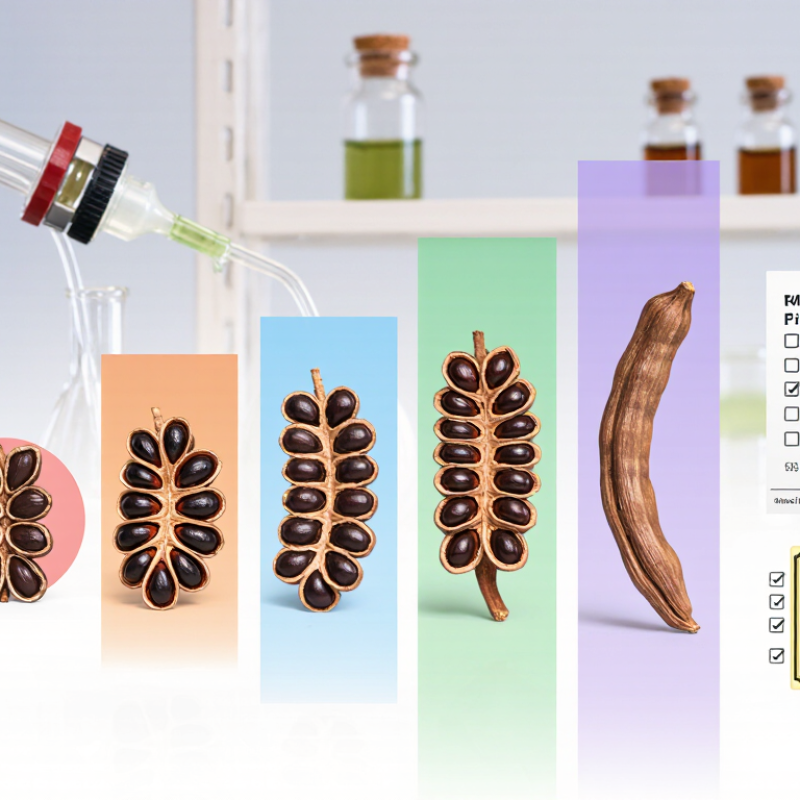
Understanding Natural Griffonia Seed Extract and Its Bulk Uses
Natural Griffonia seed extract comes from the seeds of Griffonia simplicifolia, a West African plant. It is commonly standardized for 5-hydroxytryptophan (5-HTP), a compound involved in serotonin production. Bulk buyers may encounter it in capsules, tablets, and powdered dietary blends. Formulation matters: a fine powder can disperse differently from a coarse extract, and moisture may affect storage stability.
Demand for supplements offers useful market context, though it does not measure demand for Griffonia specifically. Grand View Research estimated the global dietary supplements market at USD 177.5 billion in 2023, with projected growth through 2030. For buyers, that scale makes dependable specifications important. Request a certificate of analysis showing identity and 5-HTP assay, plus test results for contaminants and moisture. Check that the tested sample represents the supplied lot. A polished specification is helpful, but it cannot replace batch-level evidence.
Natural variation is real. Growing conditions, harvest timing, and extraction methods can influence the finished ingredient, so “natural” alone says little about consistency. That detail gets missed. Compare proposed assay ranges, packaging, and shelf-life data before placing a large order. A small trial can reveal handling issues, such as clumping or uneven blending, that documents may not show. Even then, results from one batch may not predict every future shipment.
7 Best Natural Griffonia Seed Extract Suppliers for Bulk Buyers – Understanding Natural Griffonia Seed Extract and Its Bulk Uses
This comparison describes supplier capabilities to look for rather than naming or endorsing specific companies. Product specifications, availability, and regulatory status vary by supplier and destination market; confirm them before ordering.
| Supplier capability to prioritize | Typical product or service | Bulk-buyer fit | What to verify before purchase |
|---|---|---|---|
| 1. Botanical identity and traceability | Griffonia seed extract identified as Griffonia simplicifolia, with documented origin and lot traceability. | Buyers needing reliable identification and consistent sourcing across repeat orders. | Botanical name and plant part, country of origin, batch number, and traceability documents. |
| 2. Standardized 5-HTP extract | Extract offered with a stated 5-hydroxytryptophan (5-HTP) assay; commercial specifications differ by product. | Formulators that require a defined marker-compound level for ingredient calculations and batch consistency. | Assay method, specification range, representative certificate of analysis (COA), and test results for the supplied lot. |
| 3. Independent quality testing | Lot-based testing and supporting quality documentation for identity, composition, and relevant contaminants. | Importers and manufacturers with supplier-approval, audit, or incoming-material testing requirements. | Testing laboratory, methods, limits, results, and risk-based checks such as heavy metals, microbiology, and residual solvents. |
| 4. Clear extraction and carrier information | An extract specification that identifies the extraction process and any carriers or processing aids used. | Brands and contract manufacturers managing ingredient declarations, formulation compatibility, or customer requirements. | Full composition, solvent or extraction-process details, carrier percentage, and allergen or GMO statements when relevant. |
| 5. Manufacturing and quality-system controls | Documented manufacturing controls and a quality system appropriate to the intended market and product category. | Buyers seeking a qualified supplier for ongoing commercial production. | Current certificates and audit scope, change-control process, complaint handling, and applicable food or supplement compliance documentation. |
| 6. Flexible bulk packaging and logistics | Bulk packs suited to the buyer’s order size, with protective packaging and shipment documentation. | Businesses balancing storage capacity, production schedules, freight costs, and import requirements. | Minimum order quantity, pack sizes, packaging materials, shelf life, storage conditions, lead time, and export documents. |
| 7. Application and regulatory documentation support | Technical information for evaluating the extract in supplements or other permitted product formulations. | Product developers who need ingredient data for formulation, labeling review, and market-specific compliance checks. | Technical data sheet, COA, safety information, permitted-use status in the destination market, and applicable labeling guidance. |
Griffonia seed extract is used as an ingredient in some dietary supplement formulations. Its 5-HTP content and suitability depend on the product specification and applicable regulations. Buyers should independently assess safety, interactions, claims, and legal requirements for each intended market.
Related Posts
-

7 Compelling Advantages of Using Natural Griffonia Seed Extract for Wellness
-

Top 10 Benefits of Natural Griffonia Seed Extract for Health and Wellness
-

15 Ways Ginger Powder Can Transform Your Health and Cooking
-
7 Compelling Reasons to Choose Best Gotu Kola Powder for Your Health
-
What is Green Coffee Bean Powder and Its Health Benefits?
-
How to Source High Quality Green Coffee Bean Powder Globally?