
China Top Dihydroberberine Powder Supplier?
Choosing a China-based Dihydroberberine Powder supplier calls for more than comparing prices or reading a polished product page. The market is growing, but public reports rarely isolate dihydroberberine from the wider supplement category. That distinction matters. The Council for Responsible Nutrition’s 2024 Consumer Survey reported that 75% of U.S. adults use dietary supplements. This signals broad category demand, not proven demand for this specific ingredient.
For buyers, supplier claims need product-level evidence. Request a recent certificate of analysis tied to the batch, with identity, assay, and contaminant results. Ask which test methods and qualified laboratories were used. Review the specification, manufacturing controls, traceability records, and change-notification process. A document can look complete and still leave gaps. Independent verification is worth considering, especially when comparing quotations that differ sharply.
China has a large ingredient-manufacturing base, but country of origin alone cannot establish quality. A “top supplier” should be judged by verifiable controls, responsive technical support, and consistent documentation—not a ranking badge. Ask for a small sample and compare its paperwork with the commercial batch before making broader commitments. Also confirm that intended use, labeling, and import requirements are reviewed for the destination market. No supplier is perfect. Honest answers about limitations may be more useful than confident promises. This guide examines practical checks for identifying a dependable Dihydroberberine Powder supplier without treating marketing language as proof.
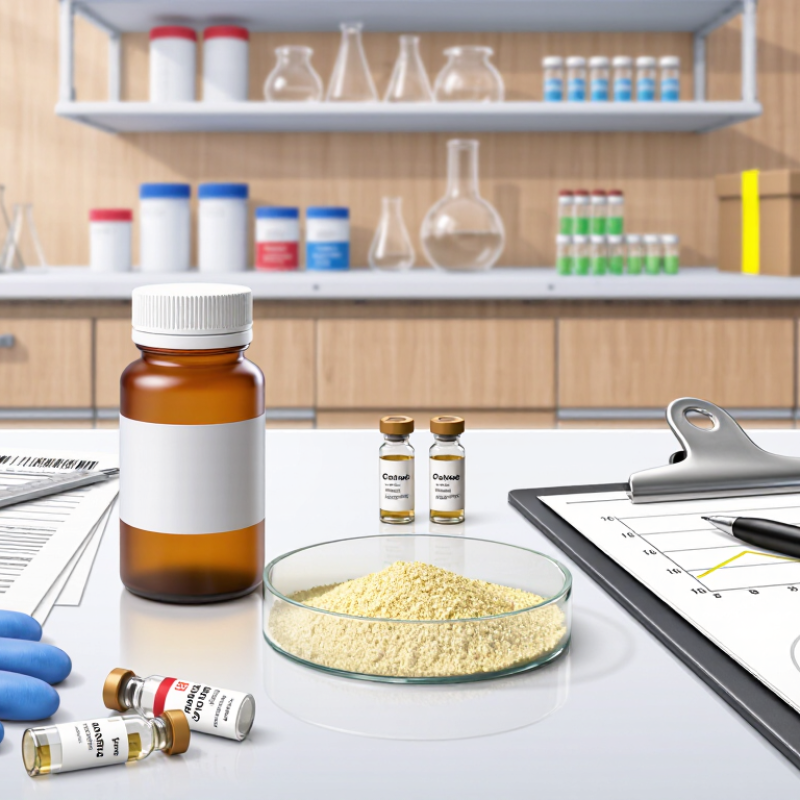
What Is Dihydroberberine (DHB), and How Does It Differ from Berberine?
Dihydroberberine, often shortened to DHB, is a chemically modified form of berberine. The added hydrogen atoms change its structure and may affect how it is absorbed. Berberine itself is a plant-derived alkaloid found in several species. It has been studied for metabolic effects, but research findings do not establish that it treats disease.
DHB is commonly described as a precursor that can convert into berberine in the body. Early research suggests it may produce higher blood levels of berberine-related compounds than standard berberine. That distinction matters. Higher measured exposure does not automatically mean greater health benefits, and human evidence remains limited. The comparison is not perfectly settled.
In practice, both compounds can vary by formulation and product quality. A label should identify the ingredient clearly and state the amount per serving. For example, check whether it lists DHB itself or berberine, since the names are not interchangeable. Look for independent testing details, not just a polished label. Even careful sourcing has limits. Anyone considering either supplement should review potential interactions and personal health factors with a qualified healthcare professional.
How Should Buyers Interpret the Reported 5-Fold Bioavailability Claim?
The “fivefold” claim needs careful reading. A frequently cited preclinical pharmacokinetic comparison reports roughly fivefold higher berberine exposure after dihydroberberine, or DHB, than after berberine in rodents. That figure describes blood-level exposure under specific study conditions. It does not show fivefold greater benefit in people. Context matters. Human results can differ with dose, meal timing, metabolism, and formulation.
The FDA’s 2014 guidance on bioavailability and bioequivalence studies emphasizes controlled comparisons, including consistent doses and study conditions. Buyers should therefore ask suppliers for the underlying study, not just a headline number. Check whether the result came from animals or people, which exposure measure was used, and whether the tested ingredient matches the offered powder. Request a batch-specific certificate of analysis showing identity, DHB content, and contaminant testing. A small detail matters: heat, moisture, and storage can affect ingredient quality. The fivefold figure is a useful research lead, not a purchasing guarantee. To date, it should not be treated as proof of fivefold human absorption or effect.
The 5× value represents a reported claim relative to a 1× reference—not a universal, independently confirmed clinical result. Bioavailability findings can vary by study design, formulation, and measurement method; the ratio alone does not establish equivalent benefits or outcomes.
Is ≥98% HPLC Assay a Verifiable Specification for China DHB Suppliers?
China Top Dihydroberberine Powder Supplier?
Is ≥98% HPLC Assay a Verifiable Specification for China DHB Suppliers?
An assay claim of ≥98% by HPLC is useful only when its basis and method are clear. Ask whether the result applies to the powder as received or to a dried sample; moisture can change the reported percentage. Request a lot-specific certificate of analysis, chromatogram, test date, and reference standard. Good documentation matters.
The method should identify the dihydroberberine peak and state key conditions, such as the column, mobile phase, detector, and calculation approach. Ask whether system suitability and method validation cover precision and linearity. An attractive chromatogram alone is not proof. Also distinguish an HPLC area percentage from a quantitative assay: they are not automatically equivalent.
Check that the sample tested matches the lot offered for shipment. If the purchase is significant, consider sending a sealed sample to an independent laboratory and comparing its results with the supplier’s report. In practice, paperwork can be incomplete. That is a reason to pause, not fill gaps with assumptions. A verifiable 98% claim should be traceable to a specific batch and supported by records another qualified analyst can review.
| Verification Dimension | What to Check | Evidence to Request | How to Interpret It |
|---|---|---|---|
| Meaning of “≥98%” | Confirm whether the figure refers to HPLC area percentage, assay by weight, or another calculation. | A written specification defining the test, calculation, reporting basis, and acceptance limit. | “≥98% HPLC” alone is ambiguous. HPLC area percentage describes the relative detector response of measured peaks; it is not automatically equivalent to 98% w/w content. |
| Test method | Review the method’s chromatographic conditions, sample preparation, calculation, and suitability for dihydroberberine. | The test method or a sufficiently detailed method summary, including the detector and column conditions. | A defined, reproducible method makes the result more assessable. The term “HPLC” by itself does not specify a complete analytical procedure. |
| Batch-specific result | Check that the reported result applies to the exact production lot offered for sale. | A dated, lot-specific certificate of analysis (COA) with the sample or batch identifier and test result. | A generic specification or sample COA does not establish the result for a different lot. |
| Identity confirmation | Verify that the tested material is identified as dihydroberberine, not merely as a high-purity chromatographic peak. | An identity test and its result, such as a documented spectroscopic or other suitable analytical comparison. | Purity and identity are separate questions; a purity percentage alone does not establish chemical identity. |
| Reference standard | Ask what reference material, if any, was used for identification or quantitative assay, and how it was qualified. | Reference-standard identity, source or qualification details, and the procedure used for comparison. | Reference-standard information helps assess traceability. A peak-area normalization result may not use a quantitative reference standard. |
| Chromatographic record | Check whether the chromatogram supports the reported result and shows the relevant sample peaks. | A sample chromatogram with peak labels and integration, plus a blank or system-suitability record when available. | Chromatograms aid review of peak separation and integration. A chromatogram alone does not prove that the method is validated or that the result is a mass assay. |
| Method validation or verification | Ask whether the method has been validated or verified for its intended use, including relevant performance characteristics. | A validation or verification summary addressing applicable characteristics such as specificity, precision, and range. | The supporting evidence should be appropriate to the method and intended claim; do not infer validation from an assay number alone. |
| Moisture and reporting basis | Determine whether the result is reported as-is, on a dried basis, or on another defined basis. | The COA’s reporting basis and, where relevant, separate moisture or loss-on-drying result. | Different reporting bases can produce different percentages. The basis must be clear before comparing results. |
| Independent confirmation | Consider testing a representative sample at an independent laboratory using an agreed method. | A third-party report identifying the sample, method, result, and reporting basis. | Independent testing can provide additional evidence for a specific sample; it does not automatically guarantee future batches. |
| Supplier conclusion | Evaluate whether the supplier provides consistent, traceable documentation for the requested lot. | A matching specification, lot-specific COA, analytical method information, and supporting records where appropriate. | A “≥98%” claim is verifiable only when its meaning, method, sample, and reporting basis are sufficiently defined and supported. This table sets out verification checks; it does not report test results for any supplier or batch. |
How Do GMP and ISO/IEC 17025 Testing Support Supplier Quality Checks?
For a dihydroberberine powder supplier, GMP and ISO/IEC 17025 answer different quality questions. GMP controls how material is received, processed, documented, and released. Buyers can check batch records, cleaning logs, deviation investigations, and traceability from incoming material to finished powder. A certificate alone is not enough.
ISO/IEC 17025:2017 addresses a laboratory’s technical competence. Accreditation applies to specific tests and locations, not automatically to every result a laboratory issues. Ask whether the lab’s accredited scope covers the methods used for identity, assay, and relevant contaminants. Review the batch-specific certificate of analysis, method references, and whether results came from the supplier’s own lab or an independent one.
The World Health Organization’s 2017 report on substandard and falsified medical products estimated a 10.5% prevalence in low- and middle-income countries. This figure is not an estimate for dietary supplements or dihydroberberine; it illustrates wider supply-chain quality challenges. That distinction matters. A careful review pairs GMP process evidence with test data from a competent lab, while checking that samples represent the actual lot. Paperwork can still miss a weak sampling plan. Ask how samples were collected, retained, and linked to the shipped batch.
Which Heavy-Metal, Microbial, and Residual-Solvent Data Should Suppliers Provide?
A dihydroberberine powder supplier should provide a lot-specific certificate of analysis, not a generic specification sheet. For metals, ask for lead, cadmium, arsenic, and mercury results, with units and the tested serving basis. USP General Chapter <2232> sets daily exposure limits for dietary supplements: 5 micrograms for lead, 5 for cadmium, 15 for inorganic arsenic, and 15 for total mercury. These are daily limits, not automatic powder limits; the supplier should show how results translate to the recommended daily intake. ICP-MS results from an ISO/IEC 17025-accredited laboratory add useful evidence. Ask whether arsenic was measured as inorganic arsenic, not only total arsenic. That distinction matters.
Microbial data should identify test methods and report actual counts, not just “pass.” USP Chapters <2021> and <2022> describe microbial enumeration and tests for specified organisms. Request total aerobic microbial count, yeast and mold, and results for organisms such as Salmonella and E. coli, including sample size and detection limits. For residual solvents, ask which solvents were used during extraction and request batch-specific GC data. ICH Q3C classifies solvents by toxicological concern; for example, its permitted daily exposure for hexane is 2.9 mg per day. A ppm result alone is hard to interpret without the serving size. Ask for both. One practical gap remains: a clean certificate cannot prove every bag is identical, so review the sampling plan and retest frequency too.
